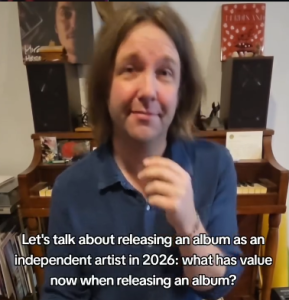

By Mark Erelli

Sound is ephemeral. Yet in its passage, sound links living beings and wakes the latent powers of biological and cultural evolution.
David George Haskell
As a singer/songwriter with a graduate degree in evolutionary biology, I have always been fascinated by the power of song. I am as moved by the pure crystalline voices of Joni Mitchell and Roy Orbison as I am the nocturnal stridulations of crickets and katydids. There is no such thing as background music for me. As a musician and scientist, I am constantly attuned and drawing meaning from my sonic environment.
In his 2022 book Sounds Wild And Broken: Sonic Marvels, Evolution’s Creativity, and the Crisis of Sensory Evolution, biologist David George Haskell luxuriates in the connective and transformative power of animal sounds. He also makes a compelling case for how the loss of wild sounds translates into a degraded environment, palpably robbing species of evolutionary potential. While Haskell’s book contextualizes the loss of biodiversity in a particularly lyrical way, we are still establishing a quantitative account of the losses themselves. Some studies estimate 3 billion fewer birds since 1970, while other meta-analyses suggest a 45% decline in some insect populations over the last 40 years. A particularly alarming aspect of these losses is that they tend to be sustained by many of the more common species (sparrows, finches, grasshoppers, and butterflies) that we tend to interact with daily.
In contrast to the staggering losses in some of our most common animal species, the most familiar musical artists in todays sonic landscape (Taylor, Harry, Beyoncé, et al.) are, while not numerous, doing just fine. However, we are on the verge of experiencing a more subtle sonic loss, though no less alarming and degrading to our cultural environment. Superstars are, by definition, rare. Most artists are “middle class musicians”—the cult heroes, journeymen and women, road dogs, and others that make up our richly diverse local and itinerant music scenes. As a member of this demographic for over a quarter century, I can assure you (despite our cheery social media posts) that many of the musical artists you respect and admire are very much hurting.
Trends in musical consumption have migrated wealth upwards, from the workers (artists) to the 1% (streaming platforms). Sales of recorded music have been largely replaced by streaming royalties that require astronomical levels of listener engagement to generate comparable income for artists. For example, middle class musicians used to sell a 10-song CD at gigs for $15. At the average $0.003 per stream royalty rate, a fan would now have to listen to that album 500 times to provide that artist a similar degree of economic support. How many of your favorite records have you listened to 500 times? And the gigs where we used to sell those CDs are drying up, too. Where I live in Boston, we’ve lost several important small music venues, beloved hubs of community where artists routinely played for enthusiastic audiences of 100 or fewer people. The small venues that are still hanging on, despite inflation and fans’ post-Covid wariness of advance ticket sales, cannot afford to take the kinds of programming chances they did only five years ago: every booking has to be a near-sellout just to keep the lights on.
Musicians were told that the internet would remove the gatekeepers and lower the bar for artistic expression, that there would be more opportunity for artists of all levels to “get your music out there.” What we got was social media juggernauts bleeding traffic away from the personal websites we invest in and control, and instead charging us to ensure that fans see our content on their platforms. Though data entry and management has never been easier or more robust, we got middleman distribution companies inserting themselves into the supply chain, taking a cut of an already meager pie to “facilitate” the upload our musical 0s and 1s to streaming services. And we got streaming services who are now angling to deny payment of minuscule royalties for songs unless they are streamed more than 1,000 times. Twenty years after WIRED magazine’s Chris Anderson proposed his now-debunked theory, to this middle class musician the “long tail” feels more like the short end of the stick.
There are those who point out that the privilege of earning a living as a musician is a relatively recent phenomenon, dating back only to the latter half of the 20th century. I grant the historical accuracy of this notion, and as a folksinger myself would be happy (and well-positioned) to return to a time when the multitudes traded tunes in the parlor or on the front porch. But there are few signs, if any, that we are poised to go back to a more musically democratic mode of musical consumption. The arts are low-hanging fiscal fruit in every public school district, the first to be slashed whenever budgetary belts must be tightened a notch or two. If we don’t teach children the inherent value of the arts and the skills involved, where are the future generations of artists going to come from? While there once seemed to be a piano in nearly every household, you probably couldn’t even give away that upright piano your parents were looking to unload when they downsized a few years ago. It’s hard to envision a future where we no longer look to professional (or semi-professional) musicians for entertainment and art that makes us think more vibrantly, and feel more alive.
This begs the question of who eventually will be able to afford to be a musician? I myself have certainly questioned my career path in the past several years. Even though I have 13 albums to my name and am well-diversified as a songwriter, band member, sideman, and producer (as well as serving as my own booking agent, publicist, social media manager, and record company), it has become harder and harder to simply afford my job, let alone make a living wage. As I’ve contemplated abandoning my calling for the first time in over two decades, I’ve been dwelling on a second, more existential question: what, if anything, does having fewer middle-class musicians mean?
We are still teasing out how our understanding of language and culture applies to non-human species. What, exactly, is being said or understood when a bird or insect calls out to others of its kind nearby? Still, we intrinsically grasp how a reduction in animal communication can have potentially far-reaching ecological consequences. If there are fewer birds, maybe that male whippoorwill’s sonorous call dissipates into the silence, making it harder draw in a remote female mate and pass their genes on to the next generation?.
But the real magic of such sonic communication is how it also migrates across the boundaries between different species. When Hank Williams heard what he perceived to be a lovelorn whippoorwill, he wrote the opening line of “I’m So Lonesome I Could Cry,” perhaps his best known song. When I first heard Williams’ country classic, I wrote a song of my own called “I Always Return.” When others express themselves, we do far more than simply receive their literal communication. We translate those sounds, filter them through our own experience, and through interpretation we make new meaning. We see ourselves and our own stories in the songs of others. Ask a hundred people to tell you about why they love their favorite songs, and you will get a hundred different stories. In this way, sonic communication is a means cultural amplification and diversification.
Declines in the natural abundance of vocal species like birds and insects logically translate into a more impoverished environment. The struggle of middle-class musicians portends a loss of cultural diversity that I don’t think we yet fully appreciate. Do we want to live in a world where we have fewer tools to help unlock our potential? What does a world that renders us less capable of enduring burdens, potentially less inspired to imagine a better future, sound like? If a tree falls in the forest, does anybody hear?
If these feel like lofty or abstract questions, take a moment to wonder: what if your favorite song never even had a chance to be written in the first place? What if your favorite musical artist’s favorite song never existed? When I ponder what it would be like to live in just such a future, I feel so lonesome I could cry.
Mark Erelli is a singer-songwriter. Learn about his and his music here.
Join us and support a music community that works for fans and artists alike.